Listen
Lyrics
Verse 1
María salió de Nazaret apenas el ángel se fue,
caminó por los cerros de Judea con la prisa de la fe.
Llevaba en Su vientre el secreto más grande del cielo,
y Sus pies jóvenes no se cansaban en el camino...
Llegó hasta la casa de Isabel, Su prima ya embarazada,
abrazó a la mujer mayor, llena de Su propia gracia.
Y allí, mi Jesús, en aquel rincón humilde de Judea,
empezó a sonar la canción más grande que el cielo cantara.
Pre-chorus
Isabel abrió la puerta, mi Jesús, y al ver a María,
sintió que el niño en Su vientre saltaba de alegría.
Y gritó — gritó con voz que el mundo nunca olvidaría…
dos palabras que el cielo entero ya conocía…
Chorus
¡Madre de Dios! Gritó Isabel con asombro y temor,
¡Madre de Dios! Temblaron las montañas al oír Su clamor.
Llevabas en Tu vientre al Hijo del Creador,
y aunque eras una niña, mi María… eras Madre del Señor.
Verse 2
Pero María, mi Jesús, no se quedó callada,
abrió Sus labios y empezó a cantar con fuego.
«A los poderosos los bajó del trono sin temblar,
a los humildes los puso a brillar más alto que el cielo.
A los hambrientos los colmó del pan que esperaban,
y a los ricos los despidió… con las manos vacías».
Y aquella niña, mi Jesús, inocente nada más,
cantó la canción más revolucionaria que el mundo cantara jamás.
Chorus
¡Madre de Dios! Gritó Isabel con asombro y temor,
¡Madre de Dios! Temblaron las montañas al oír Su clamor.
Llevabas en Tu vientre al Hijo del Creador,
y aunque eras una niña, mi María… eras Madre del Señor.
Bridge
Y María se quedó tres meses con Su prima Isabel,
ayudó a parir al niño que llamarían Juan Bautista después.
Dos primas, dos madres, dos misterios bajo el mismo cielo,
mientras lavaban pañales… empezaban a cambiar el mundo entero.
Final chorus
¡Madre de Dios! Gritó Isabel con asombro y temor,
¡Madre de Dios! Temblaron las montañas al oír Su clamor.
Llevabas en Tu vientre al Hijo del Creador,
y aunque eras una niña, mi María… eras Madre del Señor.
Tag
¡Madre de Dios! (¡Madre de Dios!)
¡La niña de Nazaret! (¡la niña de Nazaret!)
¡Madre de Dios! (¡Madre de Dios!)
…hoy y siempre… ¡Madre del Señor!
Closing reflection
Lo que Isabel gritó aquella tarde en Judea, mi Jesús,
el mundo entero lo supo después, durante siglos.
Que aquella niña humilde era la Madre del Eterno,
que el cielo y la tierra ya tenían un nombre: María.
Outro
…desde aquel grito de Isabel hasta mi voz hoy, María,
todo el mundo Te lo dice igual…
Tú eres… la Madre de Dios.
Written, performed and produced by
Take it with you
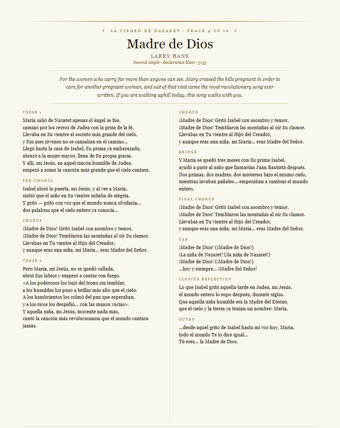
The lyric sheet for this song
A single page made to be printed: the whole lyric on bone-coloured paper, with a dedication written for this song and Larry Hans's signature. To pray it, to give it away or to keep it — not to read on one more screen.
Download the sheetFan zone
Mary leaves Nazareth as soon as the angel departs and crosses the hills of Judea in haste, carrying in her womb the greatest secret in heaven. She reaches the house of her cousin Elizabeth, also pregnant, and embraces her. Elizabeth opens the door, feels the child leap inside her, and cries out a phrase the world would never forget. Then Mary answers by singing: the powerful come down from the throne, the humble rise, the hungry are fed and the rich go away empty-handed. It is the most revolutionary song on the album, put in the mouth of a girl.
- What it's about
- The Visitation and the Magnificat — Mary crosses the hills of Judea.
- Its sound signature
- Brass with bite and women's backing vocals: this is a proclamation.
- The trick in the chorus
- It doesn't progress, and that is deliberate: «you were the Mother of the Lord» repeats identically all three times. What is proclaimed is not qualified.
- Worth knowing
- It follows Luke 1:39-56 almost literally. The title comes from the Council of Ephesus, in the year 431 — one of the oldest the Church ever gave her.
Frequently asked questions
The things people ask most about this page. If something is missing, write to the address in the footer.
What is «Madre de Dios» about?
About the Visitation and the Magnificat. Mary leaves Nazareth as soon as the angel departs and crosses the hills of Judea in haste. Elizabeth opens the door, feels the child leap within her, and cries out. Then Mary answers by singing.
What biblical passage does this song follow?
Luke 1:39-56, almost literally. It is the album's most textually faithful song: the hurried departure, the meeting with Elizabeth, the child leaping in the womb and the canticle where the powerful come down from the throne, the humble rise, the hungry eat and the rich go away empty-handed.
How long is it and where does it sit on the album?
It runs 5:55 and is track 4 of the 10 on «La Virgen de Nazaret». Its ISRC is QT6FP2692522. It opens the album's brighter half: tracks 4 and 5 are the double burst of joy.
What is this song's sonic signature?
Sharp-accented brass and female backing voices. Here the album leaves behind the intimacy of the first three tracks and proclaims: it has the most open, declarative arrangement on the record.
Why does the chorus not evolve like the others?
Because that is deliberate. «Eras Madre del Señor» (You were the Mother of the Lord) repeats identically all three times, without advancing or qualifying. In the other tracks the chorus progresses by changing a verb; here it does not, because what is proclaimed is not qualified.
Where does the title «Madre de Dios» come from?
From the Council of Ephesus, in the year 431, where the Church proclaimed Mary Theotokos, Mother of God. It is one of the oldest titles given to her, and it names the album's most declarative song.
Why is the Magnificat called revolutionary?
Because it inverts the order of the world: the powerful come down from the throne and the humble rise, the hungry eat and the rich go away empty. The song underlines that this canticle is placed in the mouth of a village girl who has just crossed a range of hills on foot.
Who is this song dedicated to?
To the women who carry far more than anyone can see. In the author's words: Mary crossed the hills while pregnant to go and care for another pregnant woman, and out of that visit came the most revolutionary song ever written.
Does this song suit 1 January or the Visitation?
Yes. It fits the solemnity of Mary, Mother of God on 1 January, which celebrates exactly the track's title, and the Visitation on 31 May, which is the scene the lyric tells.
Where can I listen to «Madre de Dios»?
On Spotify, Apple Music, Amazon Music and the other digital stores, and in the player on this page. The buttons above lead straight to this track in each store.
Where can I get the lyric of «Madre de Dios» in print?
On this page, in a PDF sheet to print with the full lyric, the dedication written for this track and the author's signature. Free, no sign-up, and available in the site's eight languages.
Which album is it on?
On «La Virgen de Nazaret» (2026), Larry Hans's debut album, of which it is track 4. It marks the point where the record moves from the intimacy of the first three tracks to open proclamation.
Who wrote «Madre de Dios»?
Larry Hans: words, music, performance and production. He is a Costa Rican singer-songwriter and a practising lawyer, and he signs all ten tracks on the album the same way.
Is the lyric translated into other languages?
No, the lyrics are always read in the original Spanish because they are the work. The song's explanation, its fact sheet and the printable page are available in the site's eight languages.
Can I use the song in a video?
The recording is under reserved rights, with ISRC QT6FP2692522. Any use in video, publication or derivative work requires prior permission, requested at soy@larryhans.com.
Thank you
I don't know your name or where you live, but the map says you were here. Thank you for putting this music on in your house, in your car or in your headphones, at whatever hour it was — every flag below is someone who stopped by to say hello.