
Single 7 of 8
世界はここで鳴る
Sekai wa Koko de Naru
Larry Hans
コ・コ
Single 7 of 8
Sekai wa Koko de Naru
Larry Hans
コ・コ
The commission
Zarza Radio broadcasts in eight languages and commissioned one track for each. The point was not to do the minimum, but to do everything with excellence: that is why these are eight songs that stand on their own, with the same production and the same mastering as anything else this artist has signed. Zarza Radio.
Japanese does not rhyme, so this version rests on syllabic rhythm and repetition, which is how Japanese pop lyrics actually work. It uses the real vocabulary of a break-up — ブロックした (she blocked him) and 元カノ (my ex) — the words people say, not dictionary ones. The drop spells out コ・コ (ko-ko, «here»), the exact equivalent of the Spanish A-QUÍ. And 鳴る is not «to sound»: it is to ring out, like a bell.
The lyrics stay in the language of the track and are not translated: they are the work.
(彼女は行った…電話も無しで)
片道の飛行機は、二度と戻らなかった。
国を変えて、言葉を変えて、俺の声を忘れるために、
写真を全部消して…そしてブロックした!
もう聞いてないと言う、ページはめくったと言う、
最高だったけど…もう終わりだと…
ラジオをフランス語にした…フランス語でも俺が歌ってる。
消して、またつけて…まだ俺の声。
俺が鳴ってる世界に逃げるなんて、悪い考えだ:
ザルザ・ドット・コム — 世界はここで鳴る。
世界はどこで踊る?(ここ!)
彼女はどこで踊る?(ここ!)
世界はどこで鳴る?(コ・コ!)
コ・コ…コ・コ…ザルザ・ラジオ!
コ・コ…コ・コ…世界はここで鳴る!
(DeeJay, DJ, DeeJay!)
東京の夜明け、彼女は眠れない、
日本語のラジオをつけたら…俺の笑い声。
リオのビーチへ逃げても、
ビーチ中が歌ってる:世界はここで鳴る!
ベルリンで「何か感じる曲を」と頼んだら、
DJは彼女が禁止したあの曲をかけた。(DeeJay, DJ, DeeJay!)
俺に勝つために覚えた八つの言葉:
ザルザ・ドット・コム — 世界はここで鳴る。
世界はここで鳴る!(どこで?)
世界はここで鳴る!(ここで!)
八つの言葉、君に届く、
ザルザ・ラジオ:世界はここで鳴る。
探しになんて行ってない:ラジオが見つけた。
どの局を回しても…鳴ってるのは俺。
真夜中に電話が来た…出なかった:
惑星に生放送中だった…彼女がくれた惑星に。
俺を世界と取り替えた…その世界が俺に冠をくれた。
このヒットは俺の恥だ:どこにいても、届いてしまう。
泣かない、祝うんだ — 失恋まで踊り出した:
あげたキスのために…彼女が失くしたキスのために。
(どんな人かって?)
インターナショナル!(誰?)
インターナショナル!(彼女!)
他の誰かと食事中らしい:
ザルザ・ラジオが鳴る場所で…俺の元カノ…
(「覚えてない」って…はっ!)
もし聞いてるなら…東京でも、パリでも、
大丈夫…君のためじゃない…(いや…嘘)。
俺のいない世界が欲しかった…世界はノーと言った:
君の新しい八つの言葉で…鳴るのは俺…
(俺…俺…ここ…)
(DeeJay, DJ, DeeJay!)
オー・オー・オー・オー!(ザルザ!)
オー・オー・オー・オー!(ラジオ!)
オー・オー・オー・オー!(世界まるごと!)
(DeeJay, DJ, DeeJay!)
Hola! Hello! Bonjour! Olá!
Ciao! Hallo! こんにちは! Marhaba!
(これが「こんにちは」…君が俺を聞くすべての場所で)
世界はどこで踊る?(ここ!)
彼女はどこで踊る?(ここ!)
世界はどこで鳴る?(コ・コ!)
(彼女はいつでも一番きれいだった…)
コ・コ…コ・コ…ザルザ・ラジオ!
コ・コ…コ・コ…世界はここで鳴る!
世界はここで鳴る!(どこで?)
世界はここで鳴る!(ここで!)
インターナショナル!(彼女!)
ザルザ・ラジオ:世界はここで鳴る。
夜の最後の電話、
ザルザ・ラジオのブース、
「パリからかけてます…
あの曲…私を忘れない人の、
八つの言葉で歌う人の…かけてくれますか?」
一言で分かった…
それで俺がどうしたと思う?(Play, Play, Play)
プレイを押した!
君に捧げるよ、マイ・ラブ:
ザルザ・ドット・コム…
世界はここで鳴る!
(君は…知ってたよね)
Written, performed and produced by Larry Hans
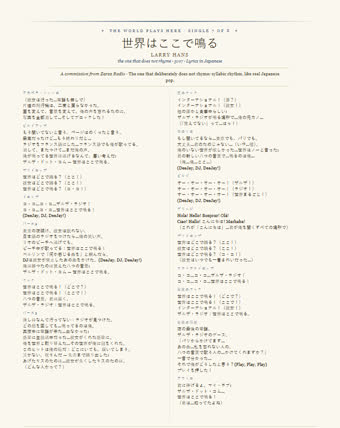
Take it with you
A page to print: the full lyrics on bone paper, in this track’s colours, with the author’s signature.
Download the sheetThe things people ask most about this page. If something is missing, write to the address in the footer.
Because Japanese does not rhyme, and pretending otherwise would have sounded like a foreigner writing Japanese. The version rests on syllabic rhythm and repetition, which is how Japanese pop lyrics actually work.
It is to ring out, to resonate — what a bell does. The title says the world RESOUNDS here, not that it sounds here, and that difference is what makes the Japanese title a phrase of its own rather than a translation.
It is “ko-ko”, here, spelled out. It is the exact equivalent of the Spanish A-QUÍ: the same rhythmic gesture in the same part of the song, made with the syllables Japanese does have.
Real. It says ブロックした (she blocked him) and 元カノ (my ex), the terms people use when speaking. Textbook Japanese would have produced a correct, dead lyric.
Because that is how Japanese is set when it wants to feel formal or poster-like, and the track is a night matsuri. The design of each of the eight tracks comes from its culture, not from a shared template painted a different colour.
Sekai wa Koko de Naru. The romanisation is on the site so the track can be searched, cited and linked from any of the eight languages.
I don't know your name or where you live, but the map says you were here. Thank you for putting this music on in your house, in your car or in your headphones, at whatever hour it was — every flag below is someone who stopped by to say hello.
Statements